
Season report
The Harbour Market, a season in review
Twenty-six Saturdays, ninety-one stalls, one very wet August.
The market officeSeptember 2026
This is the page we send to stallholders, the council and anyone who asks how the market is doing. It is also a tour of what a PageWell page can contain: headings, lists, tables, code, quotes, notes, charts, pictures and the building blocks in between. Scroll on.
In short
- Visitors were up 18% on last season, with rain the only thing that reliably kept people away.
- Food stalls now make up half of the market. Crafts held steady; second-hand books grew fastest.
- Saturdays stay. A second day is not worth it yet — the numbers below say why.
- Applications for next season open in October. The steps are at the end.
The season in numbers
Every Saturday we count people at the two gates and ask stallholders for a rough sales figure. Neither number is exact, but both are counted the same way every week, so the trend is real even when a single week is not.
- 41,300
- Visitorscounted at both gates
- 91
- Stallsat the peak, mid-July
- +18%
- On last season
- €312k
- Reported salesrounded, self-reported
Data
| Apr | May | Jun | Jul | Aug | Sep | |
|---|---|---|---|---|---|---|
| This season | 4.1 k | 6.8 k | 8.9 k | 9.7 k | 5.2 k | 6.6 k |
| Last season | 3.6 k | 5.5 k | 7.4 k | 8.6 k | 6.1 k | 3.8 k |
August is the dip. It rained on four of the five Saturdays, and the fifth was a bank holiday when half the town was away. Take August out and the season is up closer to a quarter.
Rain is the only variable we cannot plan around. Every other dip in this report has a reason we can act on.
Where the money went
Data
| Food & drink | Crafts | Books & records | Plants | Other | |
|---|---|---|---|---|---|
| Series 1 | 51 % | 22 % | 12 % | 9 % | 6 % |
Data
| 1st | 2nd | 3rd | 4th | 5th | |
|---|---|---|---|---|---|
| Food | 15.2 k | 12.8 k | 13.4 k | 11.9 k | 6.1 k |
| Crafts | 6.4 k | 5.9 k | 5.2 k | 4.8 k | 2 k |
| Books | 3.1 k | 3.4 k | 2.9 k | 3 k | 1.6 k |
The first weekend of the month is consistently the strongest, most likely because it follows payday. The fifth weekend only happens twice a season, which is why its column is short.
Who comes, and when
Data
| Walked past | A friend | Social media | Local paper | Our newsletter | Tourist office | |
|---|---|---|---|---|---|---|
| Series 1 | 34 % | 27 % | 19 % | 9 % | 7 % | 4 % |
Data
| 9 | 10 | 11 | 12 | 13 | 14 | 15 | 16 | |
|---|---|---|---|---|---|---|---|---|
| Locals | 120 | 310 | 520 | 610 | 540 | 380 | 220 | 90 |
| Visitors from out of town | 30 | 90 | 210 | 330 | 360 | 290 | 170 | 60 |
Data
| Series | x | y |
|---|---|---|
| Dry days | 11 | 1100 |
| Dry days | 14 | 1500 |
| Dry days | 16 | 1750 |
| Dry days | 18 | 1900 |
| Dry days | 21 | 2100 |
| Dry days | 23 | 2300 |
| Dry days | 25 | 2250 |
| Dry days | 27 | 1950 |
| Dry days | 29 | 1600 |
| Wet days | 10 | 400 |
| Wet days | 13 | 650 |
| Wet days | 15 | 700 |
| Wet days | 17 | 900 |
| Wet days | 19 | 850 |
| Wet days | 22 | 1000 |
Data
| The town | Under 30 km | Under 100 km | Further | |
|---|---|---|---|---|
| Series 1 | 38 | 41 | 17 | 4 |
Weekday or weekend?
Several stallholders asked for a Thursday market. We ran a trial in June. The comparison is not close.
| Saturday | Thursday trial | |
|---|---|---|
| Visitors | 1,900 on average | 410 |
| Stalls that came | 88 | 31 |
| Sales per stall | €3,400 | €720 |
| Cost to run | €1,100 | €950 |
| Verdict | Keeps going | Not this year |
☀️What worked on Thursday
Office workers came at lunchtime and bought food. The plant stalls did fine. Nobody had to queue for anything.
🌧️What did not
Crafts and books barely sold — nobody browses on a lunch break. Half the stallholders could not take a weekday off, so the market looked empty even when it was not.
What stallholders told us
We asked every stall three questions at the end of the season. Sixty-two answered.
Quotes are printed with permission. A few have been shortened; none have been changed in meaning.
The best Saturday I have ever had at any market was the second of July. The worst was the one after. That is the market — you plan for the average.
Nobody tells you that the hardest part is the van. Getting in at seven, getting out at four, and the one Saturday the harbour road is closed.
📝Three things stallholders asked for
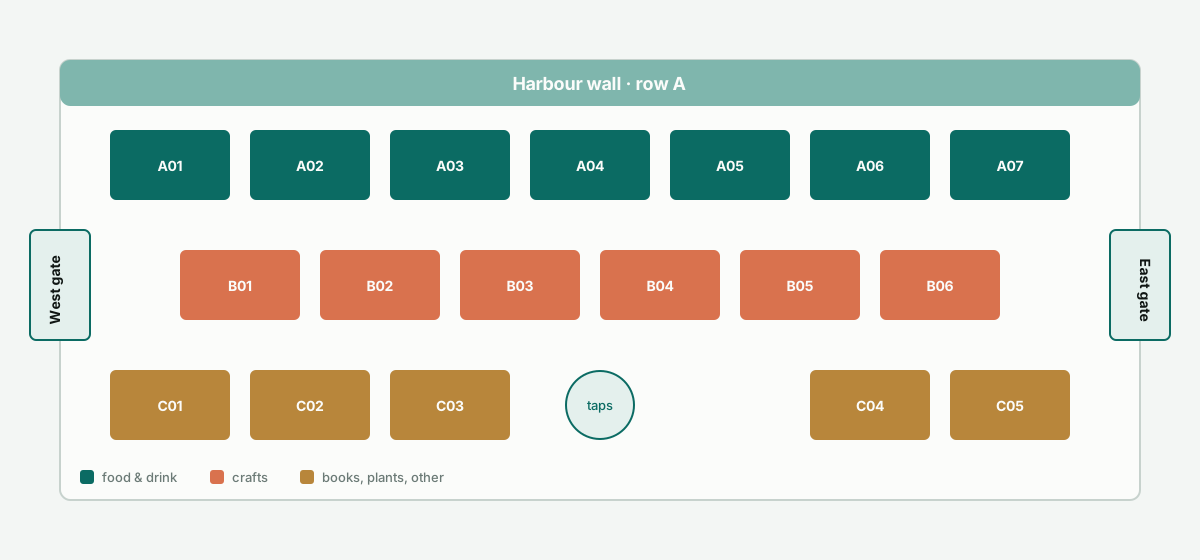
- Power at every pitch, not just the ones by the wall. We have a quote — see the plan below.
- A wet-weather plan. A covered row along the harbour wall is in the budget for next spring.
- Earlier confirmation of pitch numbers. Done: pitches are now confirmed on Wednesdays.
Can I share a pitch with another stall?
Yes, if both of you are on the register. Tell us which weeks each of you is trading so the pitch plan is right.
What happens if it rains?
The market runs unless the council closes the harbour. We refund half the pitch fee on any Saturday where the gate count is under 500.
Do you take card payments on the stalls' behalf?
No. Most stalls bring their own reader; there is a cash machine by the east gate.
The plan for next season
-
2026-10
Applications open
Returning stalls first, then new ones. The form takes ten minutes.
-
2026-12
Pitch plan published
Every stall gets a number and a map. Swaps are allowed until January.
-
2027-03
Power installed
Twelve new sockets along the harbour wall, one per pitch.
-
2027-04
Opening Saturday
The first market of the season. Bring a coat.
-
Check you are eligible
You need public liability insurance and, for food, a hygiene rating. Both take a few weeks to get, so start there.
-
Fill in the form
What you sell, which Saturdays you want, and whether you need power or water. Photos help — we choose by what the market needs, not first come first served.
-
Hear back by December
Everyone gets an answer, including a reason if it is no. Accepted stalls pay the season fee in two halves.
Returning stallholders who apply in October keep their old pitch number unless they ask to move.
Food stalls must send their hygiene certificate with the application. We cannot hold a pitch while you wait for one.
Generators are not allowed on the harbour side. If you need power there, wait for the sockets in March.
The harbour road closes for the regatta on the second Saturday of July. There is no vehicle access after 7 am that day.
Before your first Saturday
- Insurance certificate sent
- Pitch number confirmed
- Table, weights for the gazebo, a float of small change
- Read the market rules below — especially the bit about the van
The small print
Rules that come up every year
| Rule | What it means in practice | Since |
|---|---|---|
| Set up by 8:45 | Vans off the square before the gates open at nine. | 2019 |
| No generators on the harbour side | Noise carries over water. Sockets are coming. | 2023 |
| Leave the pitch clean | Take your rubbish with you; the bins are for visitors. | 2019 |
| Prices on display | Every item has a visible price. No exceptions. | 2021 |
| One pitch, one register entry | Sharing is fine, but both names are on the register. | 2024 |
The pitch plan is published as a small text file so stallholders can read it on any phone. Each line is a pitch:
# pitch  row   power  water  stall
A01      wall  yes    yes    Amadi's Kitchen
A02      wall  yes    no     Harbour Bread
B07      mid   no     no     Second Reading (books)
The office script that turns the applications into that plan is short enough to show here. It does one thing: put the stalls that need water next to the taps.
def place(stalls, pitches):
    """Water first, then power, then whatever is left."""
    by_need = sorted(stalls, key=lambda s: (not s.water, not s.power))
    plan = {}
    for stall in by_need:
        pitch = next(p for p in pitches if p.fits(stall) and p not in plan)
        plan[pitch] = stall
    return plan
Inline details, like the fee of €38 per Saturday or the A-row pitches, are marked up the same way a longer block would be. Words the council changed their mind about, like a Sunday market, stay visible so the history is honest. Footnotes go at the bottom of the page.1
The fee, worked out
We are sometimes asked how the season fee is set. It is the running cost split evenly, plus a small reserve for the wet-weather fund:
\text{fee} = \frac{\text{running cost} + \text{reserve}}{\text{stalls}} = \frac{28{,}600 + 6{,}000}{91} \approx 380That is the whole formula. A stall that trades every Saturday pays 26 \times 38 = 988, which is more than the season fee because the weekly rate includes the pitch on the days it is empty.
How an application moves
flowchart LR
  A[Application] --> B{Insurance and hygiene?}
  B -- no --> C[Ask for documents]
  C --> B
  B -- yes --> D[Pitch plan draft]
  D --> E[Confirmed in December]
Pictures from the season




Ines Varga
Market manager
Runs the office, the register and the Wednesday pitch confirmations. Ask her about power before you ask anyone else.
Email the officeThe council pageApplications for next season open on 1 October.
Read the stallholder guideTen minutes, no account needed.
Compiled by the market office from gate counts, stallholder returns and the June survey. Numbers are rounded.
-
A footnote looks like this. It is linked from the text and links back. ↩︎